Faster 3D Gaussian Splatting Convergence via Structure-Aware Densification
Max Planck Institute for Informatics, Cambridge University, and Saarbrücken Research Center for Visual Computing, Interaction, and Artificial Intelligence (VIA).

Abstract
3D Gaussian Splatting has emerged as a powerful scene representation for real-time novel-view synthesis. However, its standard adaptive density control relies on screen-space positional gradients, which do not distinguish between geometric misplacement and frequency aliasing, often leading to either over-blurred high-frequency textures or inefficient over-densification. We present a structure-aware densification framework. The key insight is that the decision to subdivide a Gaussian should be driven by an explicit comparison between its projected screen-space extent and the local structure of the texture it seeks to represent. We introduce a multi-scale frequency analysis combining structure tensors with Laplacian scale space analysis to estimate dominant local frequency, define a per-Gaussian, per-axis frequency violation metric, and perform anisotropic splitting with a multiview consistency criterion. By densifying early and more directly, the method skips lengthy iterative densification phases and achieves faster convergence with superior reconstruction quality, particularly in high-frequency regions.
Real-Time Optimization
Training visualizations show fast convergence on real-world scenes while preserving perceptual detail.
Quantitative Results
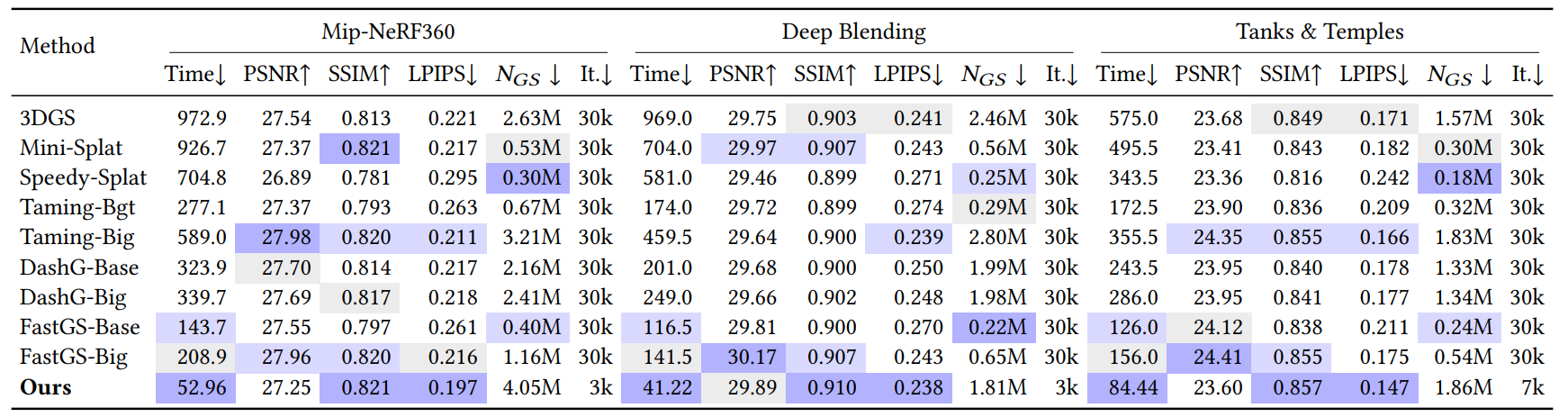
Compared with the SOTA baseline FastGS-Big, our method is 2.8x faster on average and improves LPIPS by 0.017 absolute, an 8.2% relative reduction.
Convergence Curves
The method converges faster than strong acceleration baselines while maintaining image quality.
Qualitative Comparison
Compare our reconstruction against baseline methods across representative scenes.


BibTeX
@inproceedings{lyu2026faster,
  author = {Lyu, Linjie and Tewari, Ayush and Chen, Jianchun and Leimk{\"u}hler, Thomas and Theobalt, Christian},
  title = {Faster 3D Gaussian Splatting Convergence via Structure-Aware Densification},
  booktitle = {Special Interest Group on Computer Graphics and Interactive Techniques Conference Conference Papers},
  series = {SIGGRAPH Conference Papers '26},
  year = {2026},
  month = jul,
  location = {Los Angeles, CA, USA},
  publisher = {Association for Computing Machinery},
  address = {New York, NY, USA},
  isbn = {979-8-4007-2554-8},
  doi = {10.1145/3799902.3811212},
  url = {https://doi.org/10.1145/3799902.3811212},
  numpages = {10}
}